














By Kanu Samuel
In a move to prevent taxpayer complaints from snowballing into costly disputes and court battles, the Ondo State Internal Revenue Service (ODIRS) has begun a five-day drive to overhaul how grievances are handled under Nigeria’s new tax regime.

The initiative, being implemented in partnership with the International Budget Partnership (IBP) through the UK Foreign, Commonwealth and Development Office (FCDO)-funded Partnership for Agile Governance and Climate Engagement (PACE), seeks to equip tax officials and other stakeholders with practical tools for resolving complaints before they escalate.

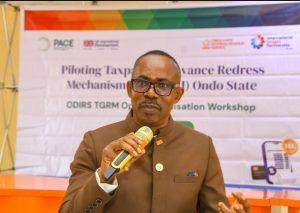
Declaring the programme open in Akure, ODIRS Executive Chairman, Mr Bayo Rojugbokan, said effective grievance management was critical to maintaining trust between taxpayers and the revenue authority.

He said the workshop was not triggered by any particular unresolved dispute but was designed to strengthen the agency’s existing mechanisms for addressing taxpayer complaints.

“There is no particular case that I can mention right now.
The new tax reform has already established a process for tax grievances management, that is, the Ombudsman,” Rojugbokan said.
“This is just to help us understand our processes of managing tax grievances. When a taxpayer raises a complaint, he is not fighting you; he just wants to be satisfied that what he is doing is not being short-changed.”

The ODIRS boss said the agency had established an Alternative Dispute Resolution (ADR) department where taxpayers could seek redress without immediately resorting to litigation.
He warned that unresolved grievances could eventually lead to taxpayers refusing to pay their taxes, creating bigger problems for both the agency and the taxpayer.
“It is not every matter we take to court,” he said. “Before you get to that point, we already have a process where you can lay your complaint about anything that is not right with us, and then we will address it internally.”

Rojugbokan urged tax officers to treat complaints as legitimate concerns rather than attempts to cause trouble, stressing that officers must deal with taxpayers with “respect” and “humility”.
He also appealed to taxpayers to use formal channels to seek redress.

“Please, if you have any complaints, don’t fight. You don’t need to fight. We are here to just administer,” he said.
IBP Senior Programme Coordinator, Chika Okoh, said the programme was particularly important because many Nigerians were still trying to understand how the new tax laws would affect them.

“Because the new tax laws are new, taxpayers, Nigerians want to know: ‘What’s this about? How does it affect me?’” she said.
Okoh said ODIRS, as one of the first points of contact for taxpayers, had a crucial role in building confidence in the new tax system.
“The idea is that if we handle taxpayers’ grievances well, it builds trust. And when there is trust, taxpayers are happy to pay their taxes,” she said.
She disclosed that Ondo was the first state selected for the TGRM pilot after baseline assessments were conducted across 10 states, adding that the programme would subsequently be extended to other states.
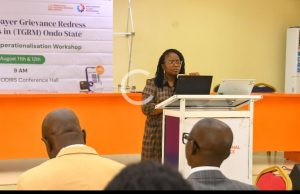
PACE Technical Project Specialist, Josiah Aramide, said the Taxpayer Grievance Redress Mechanism pilot, holding in Akure from August 10 to 14, would help ODIRS translate the 2025 Tax Reform Acts into practical systems for receiving, managing and resolving complaints.
The programme brings together revenue officials, civil society organisations, taxpayers, businesses, professional bodies, community leaders and the media.
It is expected to produce standardised grievance procedures, reporting systems and escalation pathways, while improving public awareness of taxpayer rights and reducing disputes before they reach the courts.










+ There are no comments
Add yours